
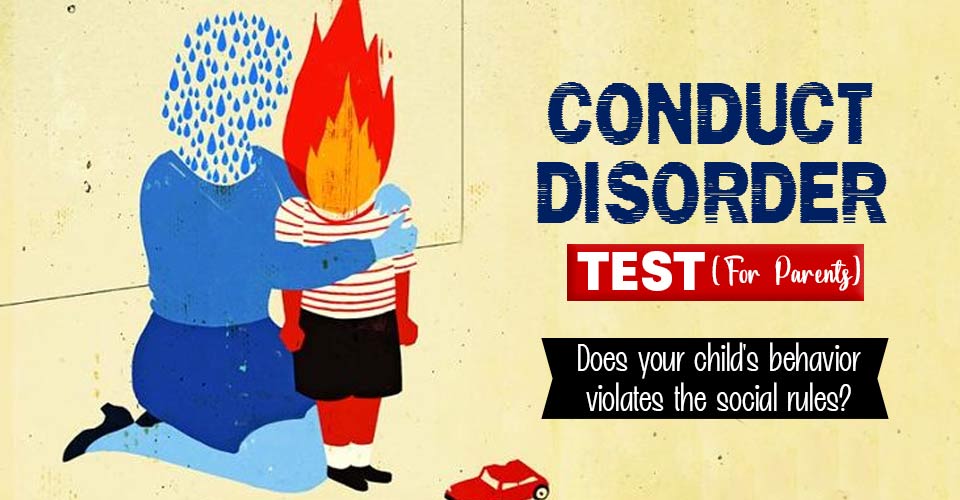
Is your child displaying aggressive behavior towards people and animals? Breaking social rules such as stealing and destroying property, engaging in physical fights and using weapons, and showing disrespect to parents and elders? These are signs of Conduct Disorder. Try this online conduct disorder test to find out if your child exhibits any of these behaviors.
What Is Conduct Disorder (CD)?
Conduct disorder is a serious behavioral and emotional disorder that occurs in children and gradually increases during the time of adolescence. Symptoms of this disorder initiate before the age of 10 years and are diagnosed till the boy/girl is under the age of 18 years.
The characteristics of this disorder are marked by patterns of-
- Disruptive and violent social rule-breaking behavior,
- Typically engaging in physical and verbal aggression,
- Theft of others’ property,
- Destroying valuable goods,
- Showing cruelty to both people and animals,
- Engaging with others in forceful sexual activities.
Adolescents with these characteristics typically run away from school/home and lie to authority figures to get the desired things from them.
Read More About Conduct Disorder Here
Instructions For Taking Conduct Disorder Test Online
Below is a list of questions that relate to the behavior common among children with signs of Conduct Disorder (CD). Please read each question carefully, and select the answers that suggest how often your child reacted in the same or similar way in the past 6 months.
Please note: This test is a self-assessment and not a diagnostic test. To diagnose a child with Conduct Disorder, symptoms must occur at least for 6 months and must initiate before the age of 10 years till the age of 18 years of the child.
Quiz Summary
0 of 15 Questions completed
Questions:
Information
You have already completed the quiz before. Hence you can not start it again.
Quiz is loading…
You must sign in or sign up to start the quiz.
You must first complete the following:
Results
Results
Time has elapsed
You have reached 0 of 0 point(s), (0)
Earned Point(s): 0 of 0, (0)
0 Essay(s) Pending (Possible Point(s): 0)
Categories
- Mental Health Assessment 0%
-
No Signs Of Conduct Disorder (CD)
Your score indicates that your child has no significant signs of Conduct Disorder (CD). The behavior that your child shows as revealed from the scores does not have any indication of social rule violation or aggression. Your response also does not indicate that your child is involved in some kind of destructive, cruel, or theft activity with other people or animals. Your responses reveal that your child shows well-adaptive and respectful disciplinary behavior in different domains of life.
However, it should be noted that this is just a basic screening tool and not meant for proper medical diagnosis. If you think the results do not accurately represent your child’s behavior, then we would encourage you to consult a mental health professional for accurate diagnosis and treatment.
Want to learn more?
Treatment of Conduct Disorder (CD) mostly involves Cognitive-behavioral Therapy (CBT), where an adolescent is helped to learn better problem-solving strategies, communication styles, and coping mechanisms to control impulses and manage anger. Apart from this family therapy also plays an important role in improving the communication skills and family interactions of the adolescent.
If you want to know how to seek help for your child or help someone who you suspect to have signs of Conduct Disorder, talk to our psychologists to better understand the prevention strategies. Disclaimer: The signs of CD would be diagnosed as a disorder, only when it would occur for at least 6 months causing significant distress in the immediate social context (e.g., family, peer group, academic, social).
You can use our Mood Tracker to stay mindful of your mood every day, identify your innermost thoughts & emotions on a daily basis. It will aid you in doing all those things you love, while limiting activities that might dampen your mood.
-
Low Signs Of Conduct Disorder (CD)
Your score indicates that your child has low significant signs of Conduct Disorder (CD). The behavior that your child shows as revealed from the scores has a low indication of social rule violation and aggression. Your response also indicates that your child is slightly involved in some kind of destructive, cruel, or theft activity with other people or animals. Also, it can be observed from your responses that your child might lie to a few extents to others to obtain the desirable things as per his/her demand.
However, it should be noted that this is just a basic screening tool and not meant for proper medical diagnosis. If you think the results do not accurately represent your child’s behavior, then we would encourage you to consult a mental health professional for accurate diagnosis and treatment.
Want to learn more?
Treatment of Conduct Disorder (CD) mostly involves Cognitive-behavioral Therapy (CBT), where an adolescent is helped to learn better problem-solving strategies, communication styles, and coping mechanisms to control impulses and manage anger. Apart from this family therapy also plays an important role in improving the communication skills and family interactions of the adolescent.
If you want to know how to seek help for your child or help someone who you suspect to have signs of Conduct Disorder, talk to our psychologists to better understand the prevention strategies. Disclaimer: The signs of CD would be diagnosed as a disorder, only when it would occur for at least 6 months causing significant distress in the immediate social context (e.g., family, peer group, academic, social).
You can use our Mood Tracker to stay mindful of your mood every day, identify your innermost thoughts & emotions on a daily basis. It will aid you in doing all those things you love, while limiting activities that might dampen your mood.
-
Moderate Signs Of Conduct Disorder (CD)
Your score indicates that your child has moderate significant signs of Conduct Disorder (CD). The behavior that your child shows as revealed from the scores has a moderate indication of social rule violation and aggression. Your response also indicates that your child in some cases is involved in some kind of destructive, cruel, or theft activity with other people or animals. Also, it can be observed from your responses that your child seems to lie to some extent to others to obtain the desirable things as per his/her demand. Also, it seems from your response that your child might have been a runaway from school/home and engaged in activities that might cause serious social consequences. The behavior of your child also seems that it might cause impairment to some extent in academic, family, social, and other domains of life.
However, it should be noted that this is just a basic screening tool and not meant for proper medical diagnosis. If you think the results do not accurately represent your child’s behavior, then we would encourage you to consult a mental health professional for accurate diagnosis and treatment.
Want to learn more?
Treatment of Conduct Disorder (CD) mostly involves Cognitive-behavioral Therapy (CBT), where an adolescent is helped to learn better problem-solving strategies, communication styles, and coping mechanisms to control impulses and manage anger. Apart from this family therapy also plays an important role in improving the communication skills and family interactions of the adolescent.
If you want to know how to seek help for your child or help someone who you suspect to have signs of Conduct Disorder, talk to our psychologists to better understand the prevention strategies. Disclaimer: The signs of CD would be diagnosed as a disorder, only when it would occur for at least 6 months causing significant distress in the immediate social context (e.g., family, peer group, academic, social).
You can use our Mood Tracker to stay mindful of your mood every day, identify your innermost thoughts & emotions on a daily basis. It will aid you in doing all those things you love, while limiting activities that might dampen your mood.
-
Severe Signs Of Conduct Disorder (CD)
Your score indicates that your child has severe significant signs of Conduct Disorder (CD). The behavior that your child shows as revealed from the scores has a strong indication of social rule violation and aggression. Your response also indicates that your child in many cases is involved in some kind of destructive, cruel, or theft activity with other people or animals. Also, it can be observed from your responses that your child seems to lie to many extents to others to obtain the desirable things as per his/her demand. Also, it seems from your response that your child seems to have been a runaway from school/home and engaged in activities that seem to cause serious social consequences. The behavior of your child also seems that it might strongly cause impairment in academic, family, social, and other domains of life.
However, it should be noted that this is just a basic screening tool and not meant for proper medical diagnosis. If you think the results do not accurately represent your child’s behavior, then we would encourage you to consult a mental health professional for accurate diagnosis and treatment.
Want to learn more?
Treatment of Conduct Disorder (CD) mostly involves Cognitive-behavioral Therapy (CBT), where an adolescent is helped to learn better problem-solving strategies, communication styles, and coping mechanisms to control impulses and manage anger. Apart from this family therapy also plays an important role in improving the communication skills and family interactions of the adolescent.
If you want to know how to seek help for your child or help someone who you suspect to have signs of Conduct Disorder, talk to our psychologists to better understand the prevention strategies. Disclaimer: The signs of CD would be diagnosed as a disorder, only when it would occur for at least 6 months causing significant distress in the immediate social context (e.g., family, peer group, academic, social).
You can use our Mood Tracker to stay mindful of your mood every day, identify your innermost thoughts & emotions on a daily basis. It will aid you in doing all those things you love, while limiting activities that might dampen your mood.
- 1
- 2
- 3
- 4
- 5
- 6
- 7
- 8
- 9
- 10
- 11
- 12
- 13
- 14
- 15
- Current
- Review
- Answered
- Correct
- Incorrect
-
Question 1 of 15
1. Question
-
Question 2 of 15
2. Question
-
Question 3 of 15
3. Question
-
Question 4 of 15
4. Question
-
Question 5 of 15
5. Question
-
Question 6 of 15
6. Question
-
Question 7 of 15
7. Question
-
Question 8 of 15
8. Question
-
Question 9 of 15
9. Question
-
Question 10 of 15
10. Question
-
Question 11 of 15
11. Question
-
Question 12 of 15
12. Question
-
Question 13 of 15
13. Question
-
Question 14 of 15
14. Question
-
Question 15 of 15
15. Question