
Bipolar disorder (BD) is a mood disorder, characterized by repeated episodes of depression and unnaturally elevated mood along with changes in levels of energy and activity. These episodes may last from several days to weeks. Understanding what are the causes of bipolar disorder may help in better treatment and coping.
[wpb_childpages parent_page_id=”2255″ post_type=”topic” post_status=”publish” sort_pages=”post_name” title=”Subtopics” style=”#topicNav{height: 350px;}”]
As per research the main risk factors and main causes of bipolar disorder involve biological, psychological, social, and environmental factors.
1. Biological Causes Of Bipolar Disorder
Research [mfn] Rowland, T. A., & Marwaha, S. (2018). Epidemiology and risk factors for bipolar disorder. Therapeutic advances in psychopharmacology, 8(9), 251–269. https://doi.org/10.1177/2045125318769235 [/mfn] attributes the common biological causes of bipolar disorder to the following factors:
I. Genetics
Studies show that monozygotic concordance and incidence of bipolar disorder amongst first-degree relatives elevate the risk of bipolar disorder by 40–70% [mfn] Rowland, T. A., & Marwaha, S. (2018). Epidemiology and risk factors for bipolar disorder. Therapeutic advances in psychopharmacology, 8(9), 251–269. https://doi.org/10.1177/2045125318769235 [/mfn].
II. Brain structure and functioning
Research shows that one of the common causes of bipolar disorder involves structural and functional changes in the brain. Dysfunctions in certain brain regions [mfn] Clark, L., & Sahakian, B. J. (2008). Cognitive neuroscience and brain imaging in bipolar disorder. Dialogues in clinical neuroscience, 10(2), 153–163. https://doi.org/10.31887/DCNS.2008.10.2/lclark [/mfn] increase susceptibility to bipolar disorders, such as :
- Overactivated ventral system
- Underactivated dorsal system
- Synaptic pruning dysfunction
- Dysregulation of dopamine and serotonin receptors
- Decreased activity in the lingual gyrus
III. Prenatal factors
Prenatal viral infections [mfn] Barichello, T., Badawy, M., Pitcher, M. R., Saigal, P., Generoso, J. S., Goularte, J. A., Simões, L. R., Quevedo, J., & Carvalho, A. F. (2016). Exposure to Perinatal Infections and Bipolar Disorder: A Systematic Review. Current molecular medicine, 16(2), 106–118. https://doi.org/10.2174/1566524016666160126143741 [/mfn], obstetric complications, and postpartum mood dysfunctions increase the risk of bipolar disorders. Studies specifically link maternal influenza infection and T. gondii infection as common causes of bipolar disorder. Moreover, pregnancy stress and lifestyle habits like maternal substance use (tobacco, alcohol, antidepressants, and recreational drugs) are also associated with bipolar disorder.
IV. Other medical illnesses
A range of chronic physical illness, neurological conditions, and brain injury [mfn] Forty, L., Ulanova, A., Jones, L., Jones, I., Gordon-Smith, K., Fraser, C., Farmer, A., McGuffin, P., Lewis, C. M., Hosang, G. M., Rivera, M., & Craddock, N. (2014). Comorbid medical illness in bipolar disorder. The British journal of psychiatry : the journal of mental science, 205(6), 465–472. https://doi.org/10.1192/bjp.bp.114.152249 [/mfn] are associated with the onset of bipolar disorders. These include:
- Stroke
- Traumatic brain injury
- HIV infection
- Multiple sclerosis
- Porphyria
- Temporal lobe epilepsy
- Irritable bowel syndrome (IBS)
- Asthma
- Obesity
- Headache disorders and migraine
Read More About Obesity Here
2. Psychological causes of bipolar disorder
The psychological causes of bipolar disorder include [mfn] McKinnon, M. C., Cusi, A. M., & MacQueen, G. M. (2013). Psychological factors that may confer risk for bipolar disorder. Cognitive neuropsychiatry, 18(1-2), 115–128. https://doi.org/10.1080/13546805.2012.702505 [/mfn]:
I. Personality traits
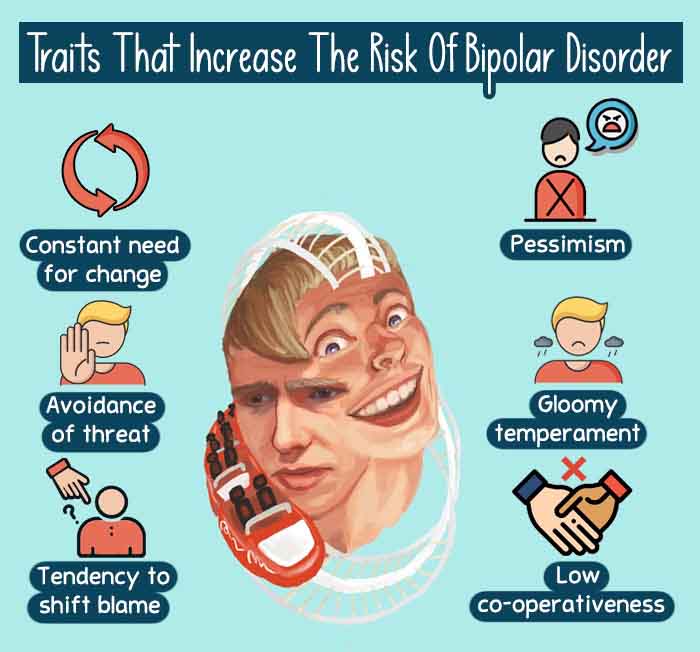
People with bipolar disorder usually show the following personality traits [mfn] Nery, F. G., Hatch, J. P., Glahn, D. C., Nicoletti, M. A., Monkul, E. S., Najt, P., Fonseca, M., Bowden, C. L., Cloninger, C. R., & Soares, J. C. (2008). Temperament and character traits in patients with bipolar disorder and associations with comorbid alcoholism or anxiety disorders. Journal of psychiatric research, 42(7), 569–577. https://doi.org/10.1016/j.jpsychires.2007.06.004 [/mfn] and temperaments:
- Novelty seeking behavior
- Harm avoidance
- Self-transcendence
- Melancholic temperament
- Decreased self-directedness
- Low cooperativeness
Read More About Personality Here
II. Neurocognitive function
Several cognitive deficits [mfn] Savitz, J., Solms, M., & Ramesar, R. (2005). Neuropsychological dysfunction in bipolar affective disorder: a critical opinion. Bipolar disorders, 7(3), 216–235. https://doi.org/10.1111/j.1399-5618.2005.00203.x [/mfn] have been associated with bipolar disorder such as:
- Working memory
- Sustained attention
- Abstract reasoning
- Visuo-motor abilities
- Verbal fluency
- General cognitive function
III. Social cognition
Some deficits in social cognition [mfn] McKinnon, M. C., Cusi, A. M., & MacQueen, G. M. (2013). Psychological factors that may confer risk for bipolar disorder. Cognitive neuropsychiatry, 18(1-2), 115–128. https://doi.org/10.1080/13546805.2012.702505 [/mfn] have also been implicated in the etiology of bipolar disorder. Some of these are:
- Emotion comprehension
- Empathy
- Autobiographical memory, etc.
Read More About Empathy Here
IV. Comorbid psychological disorders
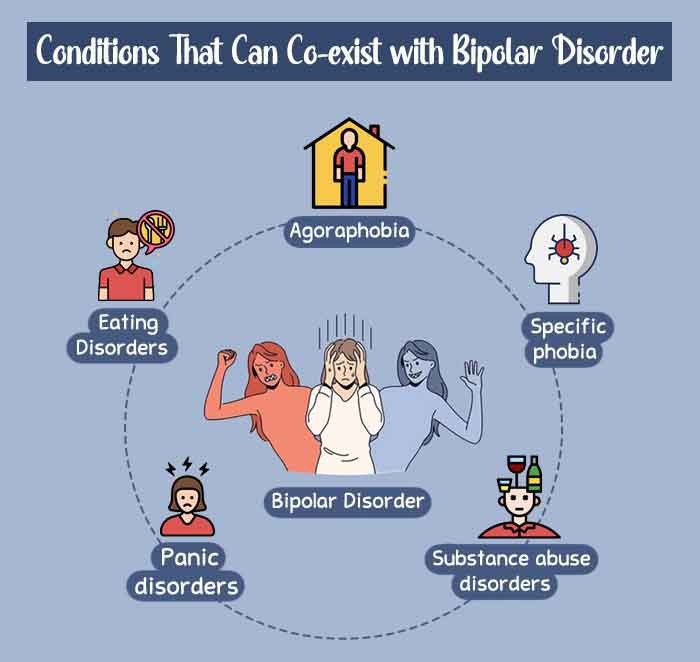
Certain other disorders [mfn] Loftus, J., Scott, J., Vorspan, F., Icick, R., Henry, C., Gard, S., Kahn, J. P., Leboyer, M., Bellivier, F., & Etain, B. (2020). Psychiatric comorbidities in bipolar disorders: An examination of the prevalence and chronology of onset according to sex and bipolar subtype. Journal of affective disorders, 267, 258–263. https://doi.org/10.1016/j.jad.2020.02.035 [/mfn] may also increase the risk of bipolar disorder, such as:
- Eating disorders [Read more]
- Agoraphobia [Read more]
- Specific phobia [Read more]
- Panic disorders [Read more]
- Substance abuse disorders
3. Social and environmental causes of bipolar disorder
The common psycho-social [mfn] Dou, W., Yu, X., Fang, H., Lu, D., Cai, L., Zhu, C., Zong, K., Zheng, Y., & Lin, X. (2022). Family and Psychosocial Functioning in Bipolar Disorder: The Mediating Effects of Social Support, Resilience and Suicidal Ideation. Frontiers in psychology, 12, 807546. https://doi.org/10.3389/fpsyg.2021.807546 [/mfn] causes of bipolar disorder include:
- Experiences of trauma [mfn] Johnson, S. L., Cuellar, A. K., & Gershon, A. (2016). The Influence of Trauma, Life Events, and Social Relationships on Bipolar Depression. The Psychiatric clinics of North America, 39(1), 87–94. https://doi.org/10.1016/j.psc.2015.09.003 [/mfn]
- Experiences of abuse (like physical, sexual, parental abuse)
- Negative life events [mfn] Aldinger, F., & Schulze, T. G. (2017). Environmental factors, life events, and trauma in the course of bipolar disorder. Psychiatry and clinical neurosciences, 71(1), 6–17. https://doi.org/10.1111/pcn.12433 [/mfn] (like the death of a loved one or experiences linked to war, terrorism, etc.)
- Social support deficits (like experiences of parental abandonment, bullying, etc.)
- Family difficulties (like dysfunctional family dynamics and experiences of divorce, domestic violence, etc.)
Takeaway
Bipolar disorder (BD) is a crippling mental health condition that leads to drastic changes in thinking, judgment, memory, behavior, and sleep. It negatively impacts our everyday normal functioning, professional lives, and our ability to form relationships.
By gaining a clear understanding of the different causes of bipolar disorder and how these affect us—we will be in a better position to seek help from a mental health professional. Understanding the causes can also enable doctors to conduct accurate diagnoses and devise customized and effective treatment plans for faster recovery.
At A Glance
- Bipolar disorder is a psychological condition that involves extreme changes in mood, behavior, and energy levels.
- It leads to severe disruptions in daily life and social relationships.
- The causes of bipolar disorder are varied—comprising biological psychological, social, and environmental factors.
- Gaining a clear understanding of the different causes of bipolar disorder can enable us to seek timely and proper treatment.
- Despite the variety of causes, bipolar disorder can be addressed by therapy, medication, and self-help strategies.